Dental Emergency? Same-Day Appointments Until 10 PM — Call 0113 245 9004
Open 7 Days a Week — Until 10pm. Call 0113 245 9004

4.8

/

3,840 reviews

Whatsapp us

Scan the QR Code to chat with our staff via your smartphone.

Next

Children's Dentistry Leeds

Specialist Paediatric Dentistry for Children in Leeds

Children’s Dentist Leeds

Positive experiences from the very beginning

Children’s dentistry is about building trust early and creating positive experiences that last a lifetime. At Clarendon Dental Spa, our specialist team provides gentle, supportive care in a calm, child-friendly environment — helping children feel at ease while giving parents complete confidence in their child’s oral health.

Dentist wearing a face mask and gloves using a dental microscope while treating a patient lying back in a dental chair.

Examinations & X-Rays / Leeds

By our specialist paediatric dentists

  • Children’s dental check-ups at Clarendons typically include a full examination of all teeth (baby and adult), a gum health check, assessment of how permanent teeth are developing, jaw and bite assessment (to spot any early orthodontic issues), and age-appropriate oral hygiene advice for both child and parent.

  • X-rays are only taken when clinically needed — usually bitewings to check between back teeth where decay is hardest to see. We use the lowest possible radiation doses and only when the diagnostic benefit is clear. Every appointment is paced for your child’s age and comfort level.

Dentist wearing a face mask and gloves using a dental microscope while treating a patient lying back in a dental chair.

Fissure Sealants / Leeds

Invisible protection for deep tooth grooves

The chewing surfaces of back teeth have deep grooves and pits that are notoriously difficult to clean — even with perfect brushing. That’s why cavities most commonly start here in children. Fissure sealants are a thin, protective plastic coating painted over these grooves, creating a smooth barrier that seals out food and bacteria. Applied in a single painless appointment, they protect the tooth for years.

Dentist wearing a face mask and gloves using a dental microscope while treating a patient lying back in a dental chair.

Fluoride Applications / Leeds

Professional-strength enamel protection for children

Fluoride strengthens tooth enamel and dramatically reduces the risk of cavities — which is why it’s in toothpaste. But professional fluoride varnish, applied by a dentist, is far more concentrated and delivers protection that everyday brushing can’t match. For children prone to cavities, those with deep grooves in their molars, or simply as a belt-and-braces preventative measure, fluoride varnish is a quick, painless and surprisingly effective treatment.
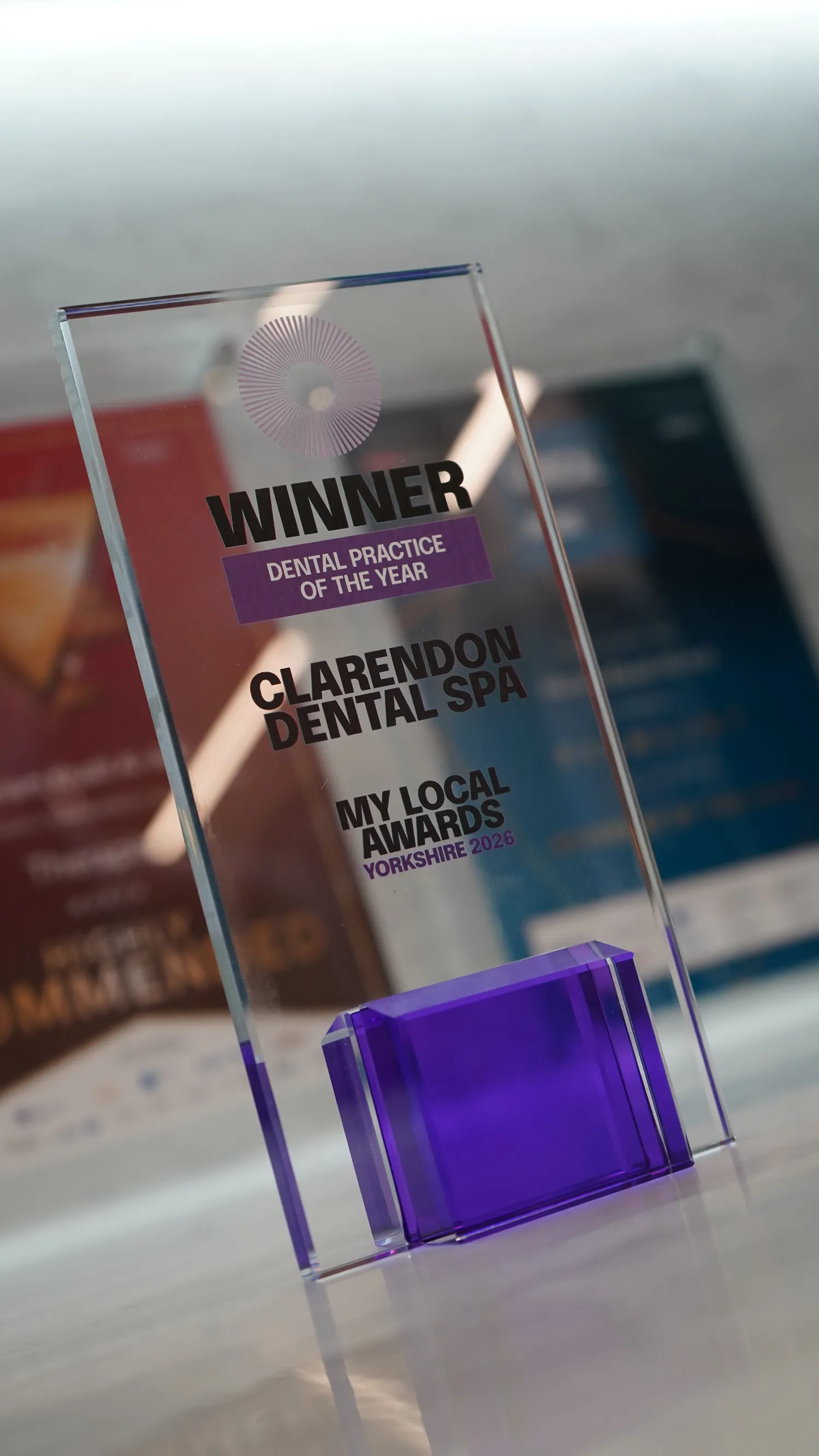
Clear glass award with a purple base reading Winner Dental Practice of the Year, Clarendon Dental Spa, My Local Awards Yorkshire 2026.

THE BRAND PATIENTS TRUST

Rated 5-stars from 3,840+ Google reviews

1

3

Dentist wearing a face mask and gloves using a dental microscope while treating a patient lying back in a dental chair.

Hygiene Education / Leeds

Personalised guidance for healthy smiles

Good oral health starts with good habits — and good habits start young. At Clarendons, we don’t just check your child’s teeth; we teach them (and you) how to look after them properly. Age-appropriate brushing techniques. Flossing guidance when teeth start to touch. Diet advice tailored to real life. Help managing habits like thumb-sucking or grinding. Practical, friendly, non-judgemental education that empowers both child and parent.

Dentist wearing a face mask and gloves using a dental microscope while treating a patient lying back in a dental chair.

Inhalation Sedation / Leeds

The gentlest way to feel calm at the dentist

Inhalation sedation — often known as laughing gas or nitrous oxide — is the gentlest, fastest-acting sedation option available in dentistry. A small soft mask delivers a mix of nitrous oxide and oxygen; within 2–3 minutes, you feel calm, relaxed and slightly floaty. Treatment continues normally — you’re fully conscious and able to respond. At the end, the mask switches to pure oxygen, and effects wear off within 5–10 minutes. No grogginess. No escort needed. Straight back to normal.

Dentist wearing a face mask and gloves using a dental microscope while treating a patient lying back in a dental chair.

Sports Mouth Guards / Leeds

Custom-fit protection for teeth, gums and jaws

Rugby, hockey, boxing, martial arts, football, even skateboarding — any sport with contact or fall risk puts your teeth, lips, gums and jaw at risk. Custom-fit sports mouthguards are the single most effective way to prevent dental injury during sport. Far better than the boil-and-bite versions from sports shops: custom guards fit precisely, protect comprehensively, and don’t fall out when it matters most.

FAQs

Your questions about children’s dentistry, answered

FAQs / Children's Dentistry / Examinations & X-Rays / Leeds

How often should my child have a dental check-up?

Typically every 6 months, though we’ll recommend an appropriate schedule based on your child’s specific risk factors (decay history, oral hygiene, dietary habits). Some children benefit from 3-monthly visits during high-risk periods (e.g., permanent teeth erupting, orthodontic treatment starting). We’ll guide you on the best frequency.

My child is nervous — what can I do?

Let us know in advance so we can allow extra time. Avoid using loaded language (“pain,” “injection”) at home — use our child-friendly alternatives instead. Read children’s books about dental visits in the weeks before. On the day, stay calm yourself (children pick up on parental anxiety). For genuinely anxious children, we offer inhalation sedation for more involved treatment.

Are X-rays safe for my child?

Modern dental X-rays use very low radiation doses — significantly lower than older film-based systems. We only take X-rays when clinically justified (e.g., suspected decay between back teeth) and use lead aprons and thyroid collars for extra protection. For most young children, X-rays are taken infrequently or not at all.

When should my child first visit the dentist?

As soon as their first tooth erupts — usually around 6 months — or by their first birthday at the latest. Early visits are familiarisation-focused rather than clinical, helping your child build comfort with the dental environment from the start. We’ll also advise you on brushing, teething and feeding habits.

FAQs / Children's Dentistry / Fissure Sealants / Leeds

Can adults have fissure sealants?

Yes, though they’re less commonly needed. Adults with deep unsealed fissures in molars, particularly those at higher decay risk (dry mouth, orthodontic treatment, history of cavities), can benefit. Ask your dentist to assess during your routine visit.

How long do fissure sealants last?

Properly applied sealants typically last 5–10 years, often longer. They’re checked at every routine visit for wear, chipping or loss. Replacing a worn sealant is quick and straightforward — usually done at a routine appointment.

Do fissure sealants hurt to apply?

Not at all. The process involves cleaning the tooth, applying a mild gel briefly, rinsing, drying, painting on the sealant and curing it with a blue light. No drilling, no injection, no discomfort. Most children find it easier than a routine check-up.

At what age should my child get fissure sealants?

The best time is shortly after each adult molar fully erupts — typically around age 6 (first permanent molars, behind the baby molars) and age 12 (second permanent molars, at the very back). Premolars can be sealed around ages 10–12 if the grooves are deep. Earlier application (to baby molars) is less common but occasionally done for high-risk children.

FAQs / Children's Dentistry / Fluoride Applications / Leeds

Can adults have fluoride applications too?

Yes — adults with high decay risk, dry mouth, receding gums (exposing root surfaces), or undergoing orthodontic treatment often benefit from professional fluoride varnish. Ask about this during your own check-ups if you’re at risk.

How often should my child have fluoride applications?

For most children, every 6 months at routine check-ups is ideal. Children at higher decay risk (due to diet, hygiene, or past cavity history) may benefit from applications every 3–4 months. We’ll assess risk and recommend frequency at your child’s appointment.

Is fluoride safe for children?

Yes — when applied by a professional at the correct dose. Professional fluoride applications have a decades-long safety record and are recommended by dental associations worldwide. The risk of fluorosis (excess fluoride affecting developing teeth) is minimal when treatment is properly dosed and spaced. Swallowing small amounts of varnish is safe in the concentrations used.

Is professional fluoride different from toothpaste fluoride?

Yes — much more concentrated. Fluoride toothpaste typically contains 1,000–1,500 ppm fluoride. Professional fluoride varnish contains around 22,600 ppm. The higher concentration, combined with direct, sustained contact with the tooth surface, delivers stronger protection than brushing alone can achieve.

FAQs / Children's Dentistry / Hygiene Education / Leeds

How can I stop my child from wanting sugary snacks?

Completely stopping sugar isn’t realistic — but managing how and when it’s consumed helps enormously. The key is frequency: one piece of chocolate with a meal is far kinder to teeth than small sweets throughout the day. Rinsing with water after sweet treats, delayed brushing (wait 30 min after eating acidic foods), and treating sweets as occasional rather than routine all help. We can give practical, non-judgemental advice at any appointment.

My child grinds their teeth — should I worry?

Tooth grinding (bruxism) is common in children, especially during ages 3–6 when teeth are coming through. It often resolves naturally as adult teeth establish. However, grinding that’s causing tooth damage, facial pain or disturbed sleep should be assessed. We’ll examine for wear and discuss options (including night guards) if needed.

Is fluoride toothpaste safe for young children?

Yes — when used in appropriate amounts. For children under 3 with no decay risk, a smear of 1,000 ppm fluoride toothpaste is recommended. For 3–6 year olds, a pea-sized amount. For 7+ year olds, full adult fluoride toothpaste is fine. Spit out excess, don’t rinse (this reduces fluoride’s beneficial effect). We’ll recommend the right products for each age.

When should my child start brushing their own teeth?

Children can start holding a toothbrush around age 2–3, but effective independent brushing doesn’t usually come until age 7–8. Until then, parents should supervise and often complete the brushing themselves. Even after age 7, spot-check brushing to make sure all surfaces are being covered. Our team will guide you on timing and technique at every visit.

FAQs / Children's Dentistry / Inhalation Sedation / Leeds

Can I stay with my child during treatment?

Absolutely — in fact, we encourage it. Parental presence provides huge reassurance for children. You’ll be able to stay close, hold their hand if appropriate, and provide comfort. The only exception is very occasional procedures where close proximity interferes with access — we’ll always discuss this in advance.

At what age can children have inhalation sedation?

Generally from age 5 upwards, though it depends on the individual child. The key requirement is that your child can understand instructions and breathe through a nose mask voluntarily. For younger or very anxious children where this isn’t possible, other approaches (longer acclimatisation visits, age-appropriate behaviour techniques) may be more suitable. We’ll assess at consultation.

Will my child be fully asleep?

No — inhalation sedation is very different from general anaesthetic. Your child stays fully conscious and able to respond throughout. They can talk, breathe normally, even move around. They just feel significantly calmer and often find the experience positive rather than stressful. Many children describe it as feeling floaty or dreamy — but never ‘out of it.’

Is laughing gas safe for children?

Yes — extremely safe when administered correctly by trained professionals. Nitrous oxide sedation has a decades-long safety record in paediatric dentistry worldwide. Your child is fully conscious throughout, breathing normally, and the effects wear off completely within 5–10 minutes of the mask being removed. Very rarely, mild side effects like nausea or headache can occur briefly after — these are uncommon and pass quickly.

FAQs / Children's Dentistry / Sports Mouth Guards / Leeds

How often should mouthguards be replaced?

Children’s mouthguards typically need replacing every 1–2 years as their teeth and jaws grow and new teeth erupt. Adult mouthguards, with normal use and care, often last 3–5 years before wear, distortion or breakdown requires a replacement. We’ll check your mouthguard at routine check-ups and recommend replacement when needed.

My child has braces — can they still play sport?

Yes — with an appropriate mouthguard designed for braces. Standard mouthguards can damage brackets or be damaged by them. We make mouthguards specifically designed to protect both teeth and orthodontic appliances, with enough internal space to accommodate brackets and wires comfortably. Essential for any child in braces who plays contact sport.

What sports need mouthguards?

Any sport with contact, impact or fall risk: rugby, hockey, boxing, MMA, BJJ, Muay Thai, karate, taekwondo, lacrosse, football (soccer), basketball, skateboarding, BMX, mountain biking, skiing, snowboarding, horse riding — the list goes on. If your sport involves contact, balls, projectiles, or the possibility of falling, a mouthguard is a very good idea.

Do I really need a custom mouthguard — why not just buy one at the sports shop?

Custom guards fit precisely, stay in place during play, allow proper breathing and speaking, and provide dramatically better impact protection. Boil-and-bite guards commonly fall out during play, feel bulky, and often fail to prevent dental injury when they’re needed most. For anyone playing contact sport regularly, the investment in a custom guard is small compared to the cost of fixing a knocked-out tooth (£1,500+ for an implant).

Two bamboo toothbrushes and a green fern leaf on a wooden dish, surrounded by tropical leaves and a paper bag on a peach background.

discover our award winning clinic

Visit Clarendons