Dental Emergency? Same-Day Appointments Until 10 PM — Call 0113 245 9004
Open 7 Days a Week — Until 10pm. Call 0113 245 9004

4.8

/

3,840 reviews

Whatsapp us

Scan the QR Code to chat with our staff via your smartphone.

Next

Dental Implants Leeds

A permanent solution for missing teeth

Dental Implants Leeds

Restoring strength beneath the surface

Dental implants offer a long-lasting, natural-looking solution for missing teeth. Designed to restore both function and appearance, they allow you to eat, speak, and smile with ease. At Clarendon Dental Spa, advanced technology and experienced implant surgeons come together to deliver precise, reliable results.

Dentist wearing a face mask and gloves using a dental microscope while treating a patient lying back in a dental chair.

3D Dental Scanning / Leeds

Precision 3D Scanning for Dental Implants in Leeds

Dental implants and complex treatments demand precision — and precision starts with seeing everything. A 3D CBCT scan (Cone Beam Computed Tomography) captures a complete three-dimensional view of your jaw, teeth, nerves and sinuses in a single 15-second scan. It’s how we plan implant surgery millimetre-perfectly. It’s how we diagnose complex problems invisible to traditional X-rays. It’s the foundation of safe, successful treatment.

Healthcare worker wearing a Tom and Jerry print scrub top, face mask, and face shield reading a document.

All-on-4 Implants / Leeds

Full arch dental implants — done in a single appointment

Replacing a full arch of teeth with individual implants would require 10+ implants. All-on-4 achieves the same result with just 4 strategically-placed implants — supporting a complete set of fixed teeth that look, feel and function naturally. For patients with failing teeth, loose dentures or multiple missing teeth, it’s genuinely life-changing. And at Clarendons, we can often fit your temporary teeth the very same day as surgery.
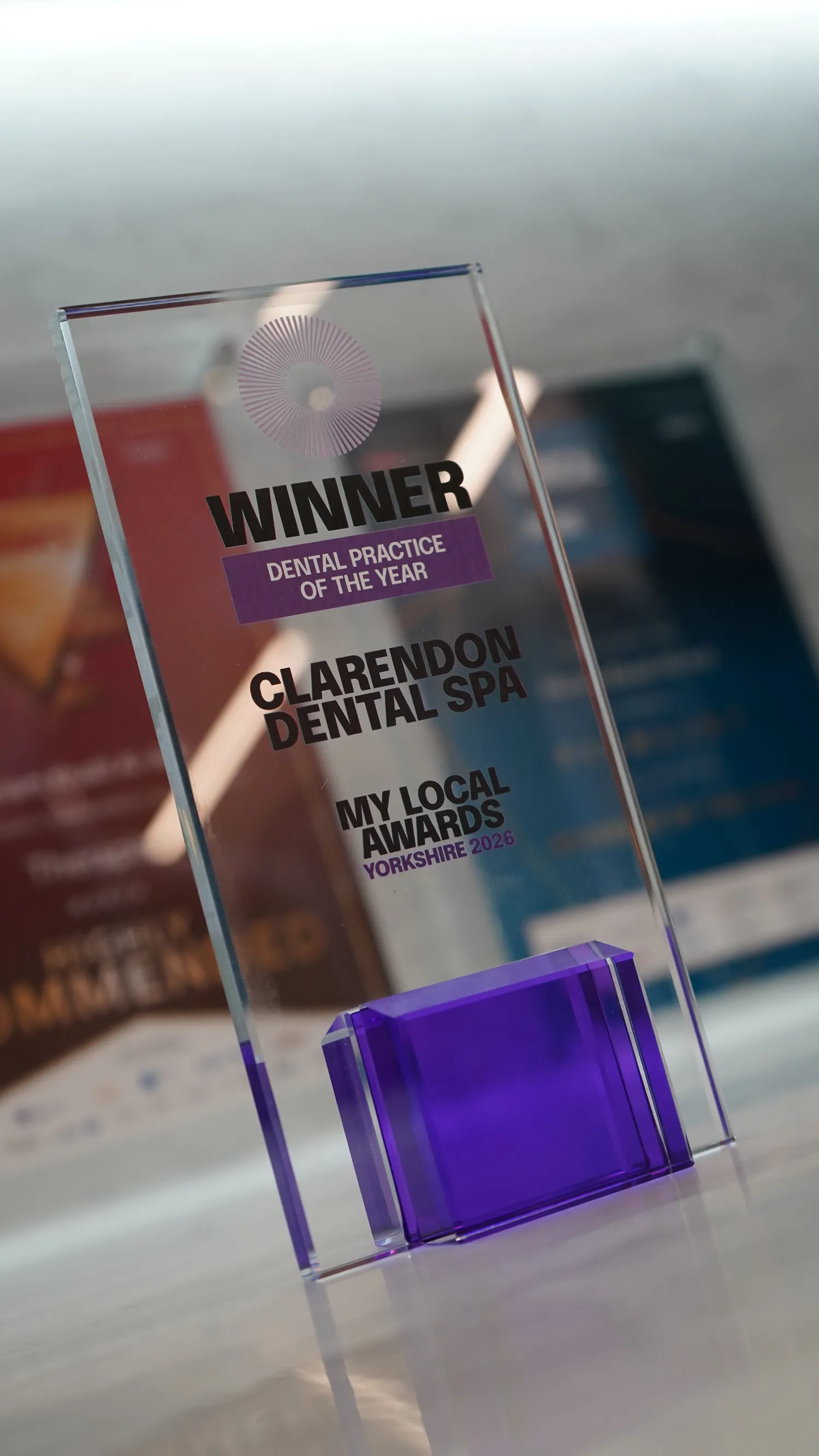
Clear glass award with a purple base reading Winner Dental Practice of the Year, Clarendon Dental Spa, My Local Awards Yorkshire 2026.

THE BRAND PATIENTS TRUST

Rated 5-stars from 3,840+ Google reviews

1

3

Dentist wearing a face mask and gloves using a dental microscope while treating a patient lying back in a dental chair.

Implant Bridges / Leeds

Fewer implants. Full results.

Missing 2, 3 or 4 adjacent teeth? You don’t necessarily need an implant for each one. An implant-supported bridge uses just 2 (or sometimes 3) strategically placed implants to support a multi-tooth fixed bridge — giving you all the benefits of implants at a lower cost than individual implant crowns. It’s efficient, economical and every bit as stable as individual implants.

Dentist wearing a face mask and gloves using a dental microscope while treating a patient lying back in a dental chair.

Implant Dentures / Leeds

The comfort of dentures. The stability of implants.

Traditional dentures slip. They cover the roof of your mouth. They affect taste, speech and confidence. Implant-retained dentures fix all of that. By anchoring your dentures to 2–4 dental implants, you get the full security of implants with the affordability and removability of dentures. No more adhesive. No more embarrassing moments. No more worrying whether they’ll stay put.

Dentist wearing a face mask and gloves using a dental microscope while treating a patient lying back in a dental chair.

Missing Teeth / Leeds

Missing Teeth Solutions in Leeds — Implants, Bridges & Dentures

Missing teeth affect everything — eating, speaking, confidence, jawbone health. Over time, neighbouring teeth drift, opposing teeth over-erupt, and the jawbone beneath the gap gradually shrinks. Dental implants fix all of that. Permanently. A titanium post placed into your jawbone acts as an artificial tooth root; a custom-made crown on top restores full function and natural appearance.

FAQs

Your questions about dental implants, answered

FAQs / Dental Implants / 3D Dental Scanning / Leeds

How long does a 3D scan take?

The scan itself takes just 10–20 seconds of actual imaging. You’ll be in the scanner for around 1–2 minutes including positioning. The whole appointment, including check-in, positioning, scan and initial review, usually takes 15–30 minutes. You’ll often see your scan data on screen before leaving.

Can you refer me for a 3D scan without treatment?

Yes. If another dentist or clinic has requested a CBCT scan for your case, we’re happy to provide one. We’ll share the scan data and (if requested) a radiological report. Standalone scan fees apply. Please bring any referral letter or specific requests from your referring clinician.

Do I need a 3D scan for dental implants?

For most implant cases, yes. 3D CBCT imaging is now considered the standard of care for implant planning because it reveals bone volume, density and the precise position of nerves and sinuses that 2D X-rays can’t show. Without a CBCT scan, implant placement relies on approximation — increasing risk of nerve damage or sinus perforation. At Clarendons, CBCT is standard for all implant planning.

Is a 3D dental scan safe?

Yes. Modern CBCT scanners use significantly lower radiation than medical CT scans — often less than an airline flight. While all medical imaging has some risk, for appropriate clinical indications the benefits (accurate diagnosis, safe implant placement) massively outweigh the minimal radiation exposure. We only recommend CBCT scans when clinically justified, and use lead aprons and thyroid collars for additional protection.

FAQs / Dental Implants / All-on-4 Implants / Leeds

Is All-on-4 surgery painful?

The procedure itself is comfortable with local anaesthetic and IV sedation. You won’t feel pain during surgery. Some swelling, bruising and tenderness in the days following is normal — prescription pain relief manages this. Most patients report they were surprised at how manageable the recovery was. Within 2–3 weeks, most are back to normal. The final result — new teeth after years of struggle — is almost always described as transformative.

Who is a good candidate for All-on-4?

Patients with advanced tooth loss (most or all teeth missing or failing in an arch), those with loose dentures they want to upgrade permanently, and patients with severely compromised teeth where individual saving isn’t feasible. Good candidates have adequate bone volume (often confirmed on 3D scanning), acceptable general health, and are committed to the aftercare. Most suitable patients are in their 50s, 60s and 70s, though younger patients can qualify too.

Can All-on-4 be done for upper teeth, lower teeth or both?

All of the above. Lower All-on-4 is common for patients with lower arch tooth loss or failing teeth. Upper All-on-4 is equally common and uses the same 4-implant concept (though some cases benefit from 5–6 implants for the upper arch, which has softer bone). Many patients have both arches treated, either together or sequentially.

Will I really have teeth the same day?

Yes — that’s central to the All-on-4 protocol. A temporary fixed bridge is attached to the implants at the end of the surgical appointment. You’ll leave with full teeth that look natural and allow you to eat a soft diet immediately. During healing, you stay on softer foods to protect the implants, and after 3–6 months the permanent final bridge is fitted.

FAQs / Dental Implants / Implant Bridges / Leeds

Is cleaning an implant bridge difficult?

Different from cleaning natural teeth, but manageable. You can’t floss between the bridge teeth the same way — they’re connected. Instead, we recommend superfloss (which threads under the bridge) and interdental brushes (which clean the gap between bridge and gum). Water flossers work brilliantly too. It takes 5–10 extra seconds a day, and becomes routine quickly. Regular hygiene appointments professionally clean the areas that are harder to reach.

How long do implant bridges last?

The implants themselves typically last a lifetime with proper care. The bridge restoration on top usually lasts 15–20 years before needing replacement due to normal wear. Regular hygiene visits and check-ups maximise longevity. Keeping the area beneath the bridge meticulously clean is essential — we’ll show you how.

Can an implant bridge replace a traditional bridge?

Yes — and in some cases, absolutely should. Traditional bridges require drilling down healthy neighbouring teeth to serve as anchors. Over 10–15 years, those prepared teeth often develop problems. Implant bridges avoid this entirely. If your traditional bridge fails or needs replacing, an implant bridge is often the best long-term solution — preserving your other teeth completely.

Implant bridge vs individual implants for each missing tooth?

For adjacent missing teeth, implant bridges are usually more cost-effective without compromising stability. Individual implants are typically preferred when: the missing teeth are not adjacent (separated by natural teeth); where isolated gaps exist; or when you want each tooth to be fully independent for long-term maintenance flexibility. For 3–4 adjacent missing teeth, bridges are usually the better option.

FAQs / Dental Implants / Implant Dentures / Leeds

How long do implant dentures last?

The implants themselves can last a lifetime with proper care. The denture portion typically needs replacing every 5–10 years as gums change shape and materials wear. The attachment clips or o-rings inside the denture may need replacing annually or every few years. Overall, implant dentures are an extremely long-lasting solution when maintained properly.

Are implant dentures fixed or removable?

Most are removable — they clip onto the implants via small attachments. You take them out for cleaning, then click them back into place. Some patients opt for ‘fixed’ implant dentures that are screwed on permanently (more like All-on-4). Removable is more affordable, easier to clean and maintain, and suits most patients best. We’ll discuss both options at consultation.

How many implants do I need for implant dentures?

It depends on the arch. For a lower implant denture, 2 implants are usually sufficient because the tongue helps stabilise a well-fitting lower denture. For an upper implant denture, 4 implants are typically recommended for full stability (the upper jaw has softer bone and the palate-less design of implant dentures needs more anchors). Your 3D scan will confirm the right plan.

Can I upgrade my existing dentures to be implant-retained?

Often, yes. If your current dentures are in good condition and fit reasonably well, they can sometimes be modified to clip onto implants after placement. For older or poorly-fitting dentures, it may be better to make new dentures designed specifically for the implants. We’ll assess your current dentures at consultation and recommend the best approach.

FAQs / Dental Implants / Missing Teeth / Leeds

Are dental implants safe for older patients?

Yes. Age itself isn’t a contraindication. Many of our implant patients are in their 60s, 70s and beyond. What matters is your general health, bone quality and gum health — not your age. For older patients or those with certain medical conditions, we adjust the treatment plan accordingly, but implants are rarely ruled out entirely. Your consultation will confirm suitability.

What if there’s not enough bone for an implant?

Bone grafting can rebuild lost bone, creating the foundation needed for successful implant placement. Techniques include socket preservation at the time of extraction, block grafts for larger deficiencies, and sinus lifts for upper back teeth. Some cases can also use specialist implants (like zygomatic implants) that anchor into other facial bones. At your consultation, we’ll assess your bone and recommend the right approach.

Can you replace multiple missing teeth with implants?

Yes — absolutely. For multiple adjacent missing teeth, we typically use fewer implants than missing teeth: for example, 3 implants can support a bridge replacing 4 teeth. For full arch replacement, techniques like All-on-4 use just 4 implants to support a fixed full set of teeth. Your options depend on how many teeth are missing and where. We’ll map out the best approach at your consultation.

How soon after losing a tooth should I get an implant?

The general rule: sooner is better, but not too soon. Bone loss begins quickly after tooth loss, and waiting years means you may need bone grafting to support an implant. However, immediate placement (at the time of extraction) isn’t always ideal — the bone and gum often need 2–3 months to heal before implant placement. The ‘sweet spot’ for most cases is 2–6 months post-extraction. We’ll advise based on your specific tooth and healing.

Two bamboo toothbrushes and a green fern leaf on a wooden dish, surrounded by tropical leaves and a paper bag on a peach background.

discover our award winning clinic

Visit Clarendons