.svg)
3D Dental Scanning
Precision 3D Scanning for Dental Implants in Leeds








3D Dental Scanning
The diagnostic tool behind every great implant
Dental implants and complex treatments demand precision — and precision starts with seeing everything. A 3D CBCT scan (Cone Beam Computed Tomography) captures a complete three-dimensional view of your jaw, teeth, nerves and sinuses in a single 15-second scan. It’s how we plan implant surgery millimetre-perfectly. It’s how we diagnose complex problems invisible to traditional X-rays. It’s the foundation of safe, successful treatment.

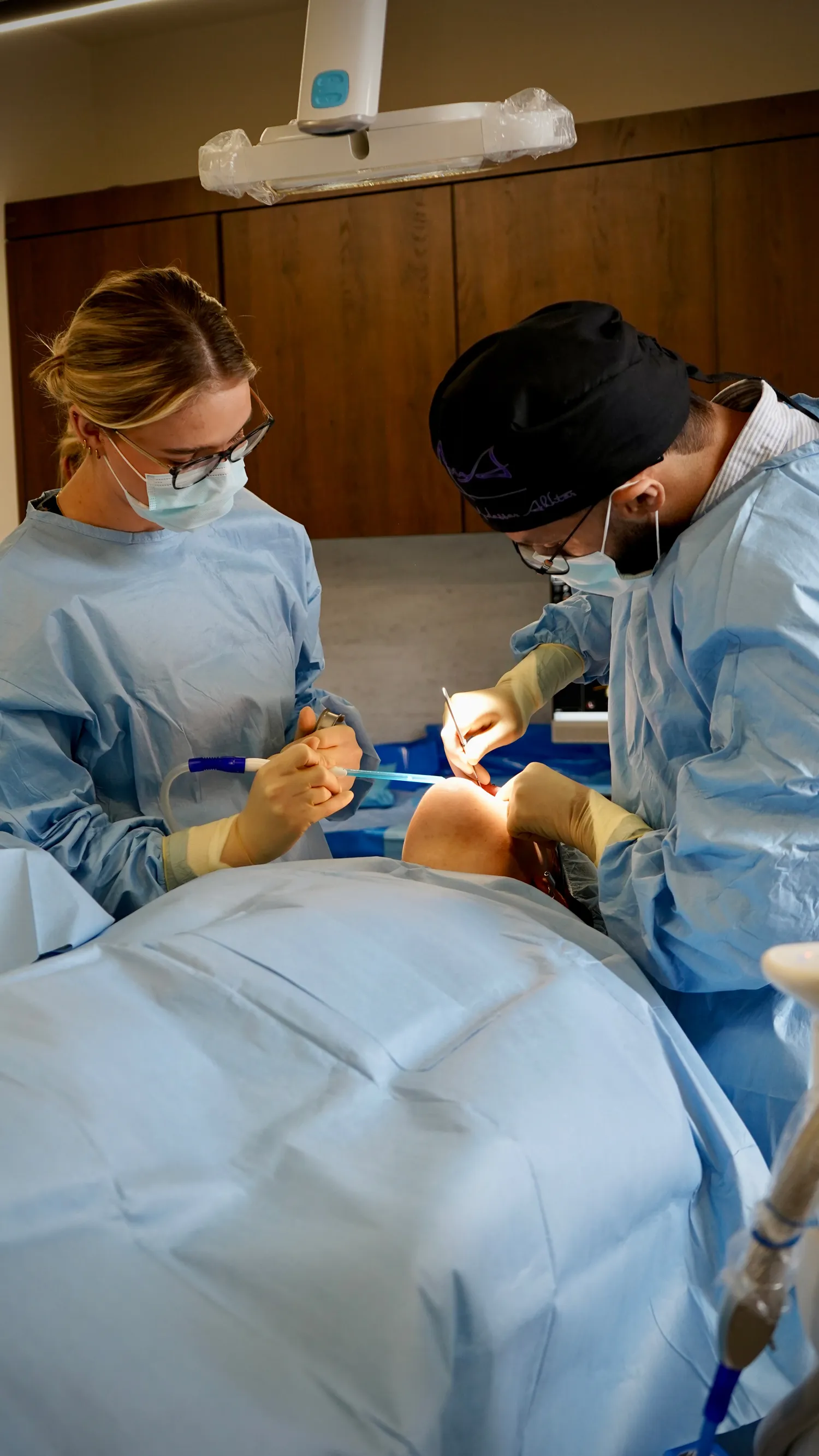

At Clarendons, every implant case includes CBCT imaging as standard. Not an upsell. Not an optional extra. Just the right way to do dentistry properly. We also use 3D imaging to diagnose other complex cases, assess wisdom teeth, and plan surgical interventions with confidence.

What is a 3D dental scan?
Clarity behind every decision
A 3D dental scan — properly called a CBCT (Cone Beam Computed Tomography) scan — uses a low-radiation X-ray beam that rotates around your head, capturing hundreds of images that are combined into a single 3D model of your jaw and teeth.
Unlike traditional 2D X-rays (which show a flat view), CBCT reveals every dimension: tooth roots, bone volume and density, nerve pathways, sinus spaces and airway anatomy. It’s used primarily for implant planning, but also diagnoses complex problems, assesses impacted teeth, plans surgical procedures, and evaluates airway issues. The scan itself takes 10–20 seconds and uses significantly less radiation than a medical CT scan.
Show more
Show less

Features and benefits
Beyond standard X-rays
Millimetre-perfect implant planning
CBCT reveals exact bone volume, density and position of nerves — so every implant is placed in the optimum position with zero guesswork. The foundation of predictable implant success.
Diagnose the invisible
Hidden infections, complex root canal anatomy, impacted wisdom teeth, cysts, tumours — CBCT reveals what 2D X-rays simply can’t show. Better diagnosis, better treatment.
Low radiation, fast scan
Modern CBCT machines use significantly lower radiation than medical CT scans. A dental CBCT dose is comparable to a few days of natural background radiation. The scan itself takes just 10–20 seconds.
The highlights


The Clarendon's Difference
Seeing clearly before treating
Too many dentists treat complex cases on guesswork and 2D X-rays. At Clarendons, if we’re doing something complex — implants, wisdom tooth removal, endodontic re-treatment, surgical procedures — we’ll usually want a 3D scan first. Because seeing everything beforehand is how we deliver predictable, safe results. And because you deserve treatment planned on complete information, not approximations.
Our award-winning clinic in Leeds city centre uses modern, low-dose CBCT technology. Scans are reviewed by our clinicians (and by specialist radiologists where needed) for comprehensive diagnosis. For referred patients from other practices, we’re happy to provide scans that can inform treatment elsewhere. And for our own patients, CBCT is the planning tool that underpins our confidence in delivering every complex case.
Show more
Show less

THE BRAND PATIENTS TRUST
Rated 5-stars from 3,840+ Google reviews

How much does a 3D scan cost?
An investment in certainty
3D CBCT scans are typically priced per scan and are often included in the cost of implant treatment packages at Clarendons. For referred patients requiring a scan only (without ongoing treatment), a standalone fee applies. At your consultation we’ll confirm whether a scan is clinically needed and the associated cost.
We are a credit broker, not a lender.
Explore more
Your smile transformation starts here. Explore what makes Clarendons different — from the team behind the work to the journeys that inspire it.